
Shoot | Move | Communicate - Owning Your Internal Mechanism
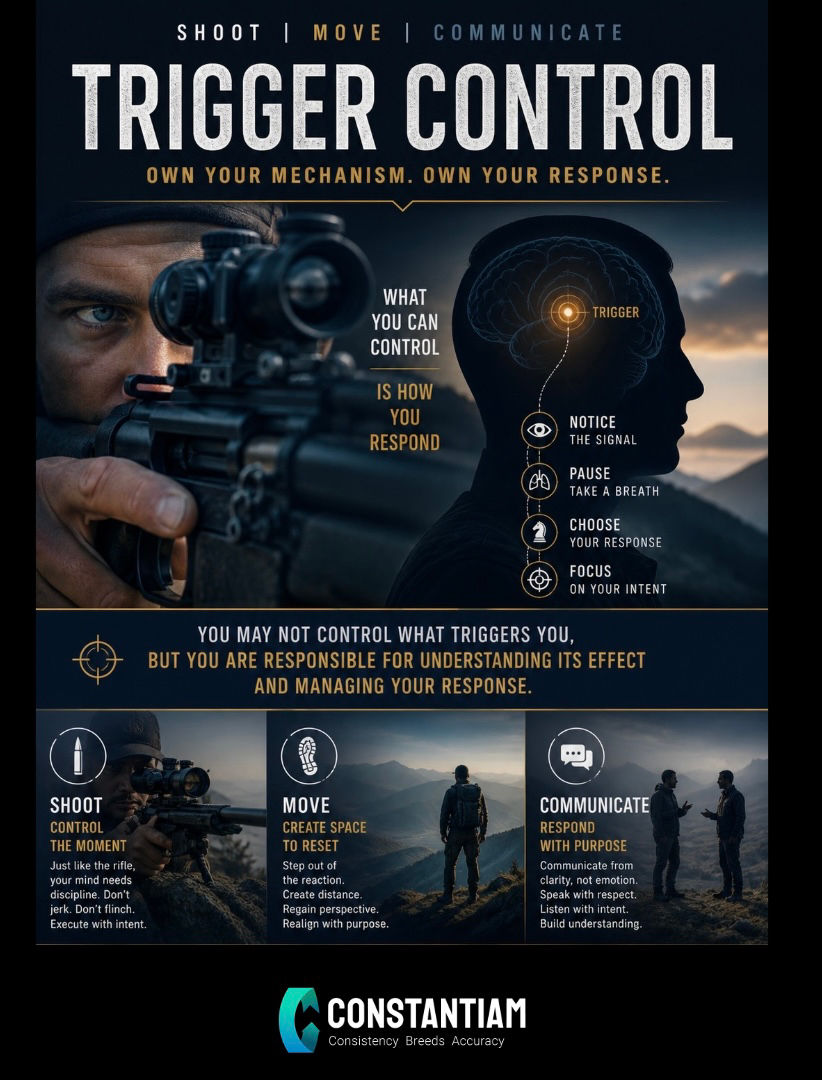
Shoot | Move | Communicate - Owning Your Internal Mechanism
“Your poor trigger control doesn’t make me responsible for your behaviour!”
After hours, days, or weeks of rigorous training, consistent preparation, and detailed planning... After the gruelling tactical insertion and the quiet discipline of waiting in the Final Firing Position... After all of this, when the moment arrives and the shot must be taken, successful marksmanship rests entirely on one fundamental discipline: Trigger Control.
Basic Marksmanship Principle 4: The shot must be released and followed through without disturbing the firer's position.
The Mechanics of the Break.
When your sight alignment and sight picture are locked onto the target, you take up the first trigger pressure. You gradually build pressure until the sear releases the hammer, striking the firing pin and igniting the percussion cap. This sparks a precise chain reaction of internal, external, and terminal ballistics - every stage of which can be completely compromised by poor trigger control.
In shooting, there are two primary ways a firer ruins a shot:
1. Jerking the trigger: Impatiently snatching at the break, snatching the weapon off target before the bullet leaves the barrel.
2. Flinching: Anticipating the recoil, tensing up in fear of the bang, and disturbing the natural point of aim.
Both errors happen at the firer's end. The target didn't cause the jerk; the environment didn't cause the flinch. The firer disturbed their own position.
The Psychological Parallel.
This exact principle correlates directly with our psychological lives. While the environment we find ourselves in constantly sends inputs, stressors, and opinions our way, far too often people blame others for their own poor behaviour, claiming to have been "triggered".
That external event may well have been the catalyst, but poor trigger control is entirely on us. Any reaction or behaviour you display remains within your own control.
Our internal "triggers" are not external attacks; they are diagnostic data. They are clear signs highlighting unhealed wounds, hidden insecurities, or rigid expectations that require our attention. If you aren’t prepared to do that internal work, you have no business blaming other people when those sensitive areas get exposed.
Deconstructing Psychological Trigger Control.
To master your internal trigger control, you must break down what happens between the initial stimulus and your ultimate response.
1. Taking Up First Pressure (Awareness).
In shooting, taking up first pressure is deliberate. It’s feeling the resistance of the mechanism before the shot breaks. In life, this equates to noticing the initial spike of emotional arousal, that sudden surge of heat in your chest, the tightening of your jaw, or the flash of anger when someone criticises your work.
Poor trigger control means instantly "jerking" into a defensive outburst, lashing out, or blame-shifting.
Good trigger control means taking up the slack: acknowledging the emotional surge without letting the hammer fall. You feel the tension, but you hold your ground.
2. Breathing Alignment (The Natural Pause).
Marksmanship teaches us to press the trigger during the natural respiratory pause, that quiet, stable moment between exhalation and inhalation when the body is naturally still.
Psychologically, this breath is your buffer. It creates the critical space between stimulus and response. In that single pause, your parasympathetic nervous system engages, lowering your heart rate and pulling you out of a fight-or-flight reaction. Instead of reacting impulsively, the breath gives your rational mind time to ask:
• "Why did that specific comment hit such a nerve?"
• "Is this about what they said, or about an insecurity I already carry?"
3. Recoil Management & Follow-Through.
In marksmanship, follow-through requires you to maintain your firing position, keep your sight picture, and observe where the round impacts through the recoil. You don't jump up or abandon your stance the moment the weapon goes off.
Psychologically, recoil is the internal emotional sting, the temporary discomfort of feeling embarrassed, challenged, or hurt.
Owning your triggers means staying grounded through your own recoil. Rather than projecting your discomfort back onto the other person to relieve your own emotional pain, you sit with the recoil. You maintain your integrity, act in alignment with your values, and use the moment to observe your own internal mechanics.
What Ownership Looks Like in Practice.
Scenario | Poor Trigger Control (Disturbed Position) | Mastered Trigger Control (Maintained Position) |
External Event | A colleague questions your strategy during a team meeting. | A colleague questions your strategy during a team meeting. |
Internal Reaction | Deep surge of shame and defensiveness (Recoil). | Deep surge of shame and defensiveness (Recoil). |
The Action | Jerks Trigger: Interrupts aggressively, attacks the colleague's competence, and blames them for ruining the vibe. | Takes Up Slack: Pauses, breathes out, regulates the physical spike, and holds position. |
Follow-Through | Position broken. Focus shifts from problem-solving to interpersonal conflict. | Maintains focus on the objective, addresses the critique constructively, and keeps sight alignment. |
Post-Shot Reflection | "They are deliberately trying to undermine me." | "Why did that challenge make me feel like that? That's an area I need to work on." |
Returning to the Basics
No matter how experienced, mature, or self-aware you believe you are, the basic principles always apply.
When you find yourself constantly in conflict, feeling defensive, or blaming your environment for your emotional state, return to the foundation. Look at your position, check your alignment, and take command of your own finger on the trigger.
Other people will inevitably cross your path and press against your sensitive spots. But whether those spots result in a controlled, constructive response or a destructive emotional explosion depends entirely on your trigger control. Take ownership of the mechanism, it belongs to you.


Comments